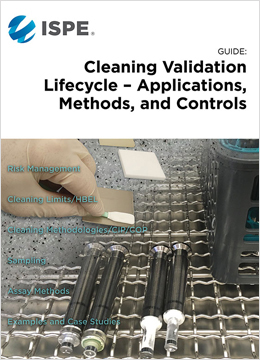
Guide: Cleaning Validation Lifecycle - Applications, Methods, & Controls
Published: August 2020
Pages: 236
Regulatory agencies expect the development and validation of a compliant cleaning program. This critical activity ensures that the risks of contamination, product carryover, and cross contamination are controlled, minimized, and monitored to safeguard patient safety and product quality.
This ISPE Guide: Cleaning Validation Lifecycle - Applications, Methods, and Controls provides a hands-on approach to support the life science industry in the development and establishment of compliant cleaning programs that meet or exceed regulatory expectations. Topics covered include:
- Application of risk management
- Adoption of a lifecycle approach for cleaning validation
- Cleaning methodologies
- Creation of cleaning validation acceptance criteria
- Determination of visual inspection limits
- Calculation and justification of residue limits
- Validation of testing and sampling methods
- Equipment issues and challenges
- Change Management
Created by a team of industry experts, this Guide is intended as a reference for the cleaning lifecycle model and a practical guide for applying the theory and concepts to help create compliant cleaning programs. It is aligned with the principles described in the ISPE Baseline® Guide: Volume 7 – Risk-Based Manufacture of Pharmaceutical Products (Second Edition).