A Practical Guide for near Concurrent Collaborative Reliance

Global chemistry, manufacturing, and controls (CMC) postapproval changes (PACs) are still managed largely through fragmented, country-by-country processes that duplicate sponsor and regulator effort, increase cost, prolong implementation timelines, add supply chain complexity, discourage continual improvement, and delay patient-centric enhancements.
Reliance and work-sharing pilots have demonstrated the advantages of streamlining global approvals. Insights from the pilots conducted so far suggest that decision timelines are projected to span six to nine months rather than three to five years.1, 2, 3 Specifically, the Amgen PAC reliance collaboration pilot showed that 23 of 27 participating authorities approved the change within nine months, compared with approximately 36 months under a conventional PAC approach.1
However, many of these pilots are proof-of-concept projects with different procedures, organizations involved, and jurisdictional requirements. All of this contributes to divergence in ways of working and potential for substantially different outcomes. Despite these challenges, the pace of change in digital capabilities is accelerating and global interest in regulatory collaboration is increasing, creating an urgent need to proceduralize reliance and collaborative review. The current opportunity is to move beyond individual pilot efforts toward a simpler collaborative approach for global PAC implementation that streamlines regulatory assessment, lowers operational burden, and increases accessibility for patients worldwide.1, 4, 5, 6
These efforts build on harmonized life cycle-management concepts described in International Council for Harmonisation of Technical Requirements for Pharmaceuticals for Human Use (ICH) Q12, including the use of postapproval change management protocols (PACMPs) to support more predictable and efficient implementation of PACs.7, 8 Recent analyses have highlighted the increasing complexity of global postapproval change management and the need for more efficient and predictable approaches that facilitate continual improvement and product availability.9
Herein, we propose that the next step to enable broader reliance and collaboration is a straightforward process that applies generally across organizations, regions, and filing scenarios. A cloud platform and a global core dossier should support the process to enable real-time collaboration among regulators. This process-oriented proposal also aligns with the broader call for a cohesive future vision built around a global CMC dossier and greater convergence across digitalization, standards, and collaboration initiatives, so modernization does not create new forms of fragmentation.10 When used consistently, this process can reduce duplicative work, support regulator collaboration around the same data package, and shorten the path to implementing PACs across markets.
What Recent Pilots Clarify About Reliance and Collaboration
Reliance is distinct from recognition, in which one authority accepts another authority’s decision without further assessment. This is different from work-sharing, in which two or more authorities divide review activities and assess in parallel.11, 12 The World Health Organization (WHO) defines reliance as when a regulatory authority gives significant weight to assessments or other authoritative information from another regulatory authority or trusted institution while remaining fully independent, responsible, and accountable for its own final decision.12 The distinction between reviewing paradigms matters because many recent PAC pilots have not been pure reliance exercises; instead, they have combined elements of reliance, shared reviews and work-sharing, and regulator-to-regulator collaboration.4, 5, 6
Early PAC reliance pilots showed the value of giving multiple authorities access to the core global dossier simultaneously. The European Medicines Agency’s (EMA’s) post authorization change pilots made the same European Union (EU) variation package and assessment outputs available to participating non-EU authorities. Roche’s PAC reliance case used simultaneous access to the same EMA variation package, Committee for Medicinal Products for Human Use (CHMP) assessment report, and question and answer (Q&A) materials to compress timelines while preserving each authority’s discretion. These experiences showed that reliance can be operationalized in a way that speeds review without displacing national autonomy and decision-making.4, 5
Subsequently, collaborative pilots have demonstrated additive benefit when authorities do more than review the same materials independently. International Coalition of Medicines Regulatory Authorities (ICMRA)’s ICMRA Collaborative Assessment Pilot for PACMPs demonstrated a harmonized 120-day timetable, 88% harmonization of technical information requests, and a reduction in total information requests.6 Regional work-sharing initiatives such as ZaZiBoNa (a collaborative medicines review program among regulators in Southern Africa) likewise showed the value of shared assessment while highlighting the limitations of fragmented national submission and tracking after the joint review stage.13 Because of these pilots, the need for more accessible information technology (IT) infrastructure has become increasingly clear: ICMRA identified practical limits to Share-Point-based collaboration6 and the Access Consortium is now moving toward a cloud-based workspace to support joint reviews.14
Amgen’s Vectibix pilot represents a further step toward a simpler real-time parallel reliance-plus-collaboration process. In this pilot, a core CMC dossier was delivered and made available to participating health authorities at the same time through a cloud-based platform. Although each participating health authority had access to the platform, the extent of its engagement was neither mandated nor governed by a synchronized review timeline. Q&A exchange through the platform was enabled in a regulator-only workspace while preserving each authority’s decision-making independence. In this pilot, 23 of 27 participating national regulatory authorities (NRAs) approved the PAC within nine months, compared with approximately 36 months under a conventional PAC approach, where sequential country-by-country submissions, differing national requirements, repeated Q&A cycles, and varying approval timelines across markets can substantially delay global implementation.1 Taken together, these pilots suggest that acceleration and efficiency gains could be greater when reliance is combined with cloud-based collaboration around the core dossier1, 4, 5, 6
From Reliance to Collaboration: A Simpler Operating Framework
Based on our previous experience, we propose a simpler, more flexible process for global PACs. This practical approach starts from a core regulatory dossier that is made available to participating health authorities at the same time, while allowing individual decisions as to the extent of collaboration and leveraging additional information in the shared, regulator-only workspace. Simultaneous access to the dossier would not replace national procedures, but it supports transparency and strengthens trust.
Despite these challenges, the pace of change in digital capabilities is accelerating and global interest in regulatory collaboration is increasing, creating an urgent need to proceduralize reliance and collaborative review.
From a tactical standpoint, the sponsor continues to submit the core dossier to each health authority through conventional national channels so that local legal, administrative, and classification requirements are satisfied. In parallel, the core dossier is made available in a secure collaborative environment, giving participating authorities contemporaneous access to the same evidence rather than requiring sequential handoffs. Each authority may then determine the extent of collaboration that fits its legal framework and resources: conduct its own review, use another authority’s assessment as an input, collaborate actively with peer authorities, or combine these approaches. No single reliance pathway, synchronized review clock, or common decision date is imposed.
A platform-enabled process is most useful when there are mechanisms to clearly delineate sponsor-to-regulator exchange spaces from regulator-to-regulator collaboration spaces. A shared sponsor–regulator workspace can provide common visibility to the dossier, formal responses to questions, and status updates. A regulator-only workspace can let authorities compare emerging issues, view peer questions or draft information requests, and decide whether to use or build on one another’s analyses. Health authorities retain control over what they share with peers and what they choose to use. Framed this way, the process enables streamlined collaboration and reduces duplicate assessments and information requests.
Benefits for Regulators, Sponsors, and Patients
For regulators, the main benefits are flexibility, increased transparency, and resource sharing. Authorities see the same evidence, and each can determine how much to collaborate or rely on peer work based on its own needs, legal framework, and resources. For agencies facing backlog or capacity constraints, analysis performed by one authority can be used by others if they choose, rather than duplicated across every market. This improves efficiency without requiring regulators to surrender decision-making independence or adopt a mandated global clock.1, 4, 5, 6
For sponsors, using a common dossier can reduce duplicative dossier preparation, tracking of country-specific variants, and repetitive responses to similar questions across markets. Fewer, more harmonized questions can also consolidate response preparation across authorities. These factors can reduce the cost and complexity of staggered country-by-country submissions, decisions, and implementation.1, 4, 5, 6 Even if dual delivery (i.e., national submission plus platform upload) persists, that incremental burden is much smaller than repeated authoring, sequentially staggered submissions, redundant Q&A cycles, and scientific rereview of the same data package across dozens of jurisdictions over an extended global timeline.
Patients also benefit when global PAC implementation timelines are shortened. Manufacturing improvements that support supply continuity, scaling up to meet demand, process modernization, or product delivery optimization can reach markets sooner. The patient value of this collaborative process is tied directly to reducing the time between approval of an important quality change in one part of the world and access to the most optimal version of an approved product across markets.1, 4, 5, 6, 12
Challenges and Concerns
Sovereignty, Legal Fit, and the Misconception That Collaboration Weakens National Authority
A persistent concern is that broader reliance or collaboration could weaken sovereignty. Existing reliance frameworks do not support that conclusion. The WHO, Agência Nacional de Vigilância Sanitária (ANVISA), EMA, Medicines and Healthcare Products Regulatory Agency (MHRA), and South African Health Products Regulatory Authority (SAHPRA) all describe reliance in ways that preserve national responsibility for the final decision, even when external assessments are used as important inputs.4, 11, 12, 15 The proposed process strengthens that principle: Each authority decides the extent to which it collaborates, ranging from independent review with visibility into shared materials, to partial or more extensive use of another authority’s work, to active collaboration with peers. Because the process does not require all authorities to use the same legal mechanism or timeline, it is also better suited to jurisdictions with different statutory or procedural constraints.
Confidentiality, Information Sharing, and Data Governance
A broader collaboration framework must also answer practical questions about what is shared, with whom, and under what rules. The sponsor can provide the core dossier to all participating authorities, but regulators should control what they share among themselves, whether peers can see assessment outputs, and whether draft questions or other work is exposed in a regulator-only space. Clear governance is also needed around public versus nonpublic assessment reports, sponsor authorization, confidentiality obligations, data ownership, data residency, and cybersecurity. For example, ICMRA’s pilot required confidentiality agreements and sponsor authorization letters before authorities could discuss submissions with one another, building on the earlier reflection paper by ICMRA, ICH, the International Pharmaceutical Regulators Programme (IPRP), and the Pharmaceutical Inspection Co-operation Scheme (PIC/S).16
An earlier publication outlined a shared vision for Pharmaceutical Quality Knowledge Management (PQKM) and regulatory collaboration; the subsequent ICMRA-ICH-IPRP-PIC/S joint work plan explicitly includes governance of a secure standardized technology platform alongside data security, financing, and unique identifiers as core work items for PQKM.6, 17 Subsequently, ICH established the PQKM Technology Platform Task Force to assess requirements for development and governance of a secure standardized technology platform for PQKM.18 Nevertheless, all of these governance issues will need addressing. A permissioned collaborative environment can support these governance requirements by providing controlled access to information, supporting confidentiality and sponsor authorization requirements, and providing a secure framework for information sharing among participating authorities.17, 19
Resource Burden
The ICMRA pilot program found that collaboration can add coordination, consensus-building, and project-management work for regulators even as it reduces duplicated technical questions. However, the same report also found that more than 95% of survey respondents reported that the benefits outweighed the additional resource requirements.6 For resource-constrained authorities, the more relevant question is not whether collaboration requires effort. It is whether repeated reassessment of the same PAC across many jurisdictions is the best use of scarce expertise when shared analysis may be available. If a simplified platform-enabled process reduces duplicate work and streamlines review activities, resource pressure argues for better process design and tooling, not for staying with fragmentation by default.
Scope and Applicability to Common Sponsor Scenarios
Not every sponsor will want to file the same PAC in every region at the same time, and some companies will continue to prefer bespoke submission strategies depending on product and demand needs. These preferences and submission-specific needs do not negate the usefulness of the proposed collaborative approach. The same process and digital infrastructure can still be used for a selected set of participating authorities or within a phased global strategy. Likewise, concerns about updating legacy specifications in certain countries, or about providing more information than a market has historically received, should be handled through clearer eligibility criteria, defined dossier boundaries, and country-specific administrative requirements. Since the overall decision timeline for a PAC using this process is faster, the specific concern about providing more information to certain markets should be mitigated. Resistance to changing established filing practices comes from both internal and external sources, but it is primarily a human mindset issue and ultimately a change-management challenge, not an argument against transformation.
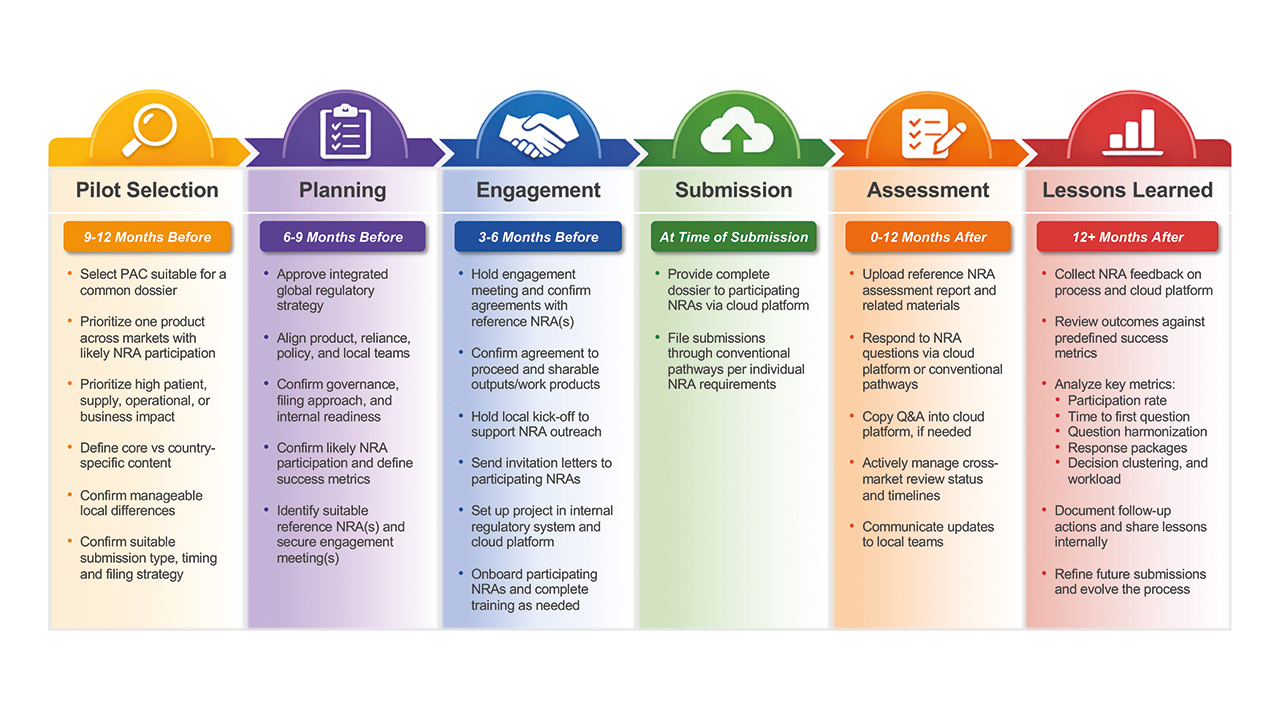
Figure 1. Sponsor-led process for real-time, platform-enabled regulatory reliance and collaboration for global CMC PACs. End-to-end, time-sequenced process spanning pilot selection, planning, engagement, submission, assessment, and lessons learned, illustrating how a single CMC PAC dossier is prepared, shared via a cloud platform, and assessed across participating national regulatory authorities (NRAs) using elements of reliance and collaborative review, with coordinated question management and predefined metrics to evaluate outcomes.
Proposed Real-Time Reliance/Collaboration Process
To move from isolated pilots to a reusable business process, sponsors and regulators need more than general high-level agreements. They need a defined operating sequence that explains what is filed, where collaboration occurs, how national authority is preserved, and how success will be measured. The overall objective of this framework is to let a sponsor provide a core dossier to multiple authorities at the same time, while allowing each authority to decide whether to use reliance, collaborate with peer authorities, or combine these approaches.
Core Principles
This process rests on four core principles:
- Participation should be self-directed by each health authority: the extent to which an authority uses reliance and collaborates is for that authority to determine, and no common decision date or synchronized timeline is mandated.
- The sponsor should continue to meet local legal and administrative requirements through conventional national submission routes, as needed, while making the core dossier available in a preferred cloud-based collaborative environment.
- Duplicate entry, country-specific forms, and site-specific administrative tailoring should remain sponsor work rather than regulatory agency work; the process should reduce scientific duplication for regulators, not create new administrative burden for them.
- Regulators should retain control over what they share with peers, what they use from other authorities, and how they apply any external assessment in their own national decision-making.
Real-Time Reliance/Collaboration Process
Step 1: Pilot Selection (Nine to Twelve Months Prior to Submission)
The process should begin with an internal selection of a PAC by the sponsor that is suitable for a common dossier to be reviewed across multiple jurisdictions. Selection should consider whether local administrative differences can be managed without fragmenting the scientific package. The best candidates are changes for which there is one manufactured product across participating markets, and for which delayed global implementation creates meaningful operational, supply, or life cycle burden. Examples of possible selection criteria are listed in Figure 1 and can be weighted differently from pilot to pilot. At this stage, the sponsor should define the common dossier boundary: what is truly shared scientific content (“core dossier”), what remains country-specific, and what administrative elements must stay outside the shared package.
Step 2: Planning (Six to Nine Months Prior to Submission)
Once the pilot candidate is selected, the sponsor should begin planning and confirm governance, filing approach, and internal readiness before initiating broader external engagement. This includes approval of a global regulatory strategy and alignment across product, reliance, policy, and local teams. Planning should also assess whether enough authorities are likely to participate to justify the effort and success metrics are defined in advance. The sponsor should then identify the reference NRA and secure an engagement meeting with that authority. A good reference on health-authority participation in reliance pilots, which can inform selection of candidate reference NRAs and likely participating jurisdictions, is the presentation by the European Federation of Pharmaceutical Industries and Associations’ (EFPIA’s) at the California Separation Science Society (CASSS) Well-Characterized Biopharmaceutical Product (WCBP) 2026 Symposium, which summarizes prior reference authorities and participation patterns across multiple completed and ongoing PAC pilots.20
Based on recent pilots, suitable reference NRAs are those that can provide assessment outputs that:
- Are sufficiently transparent, shareable, and usable by other authorities
- Can support reliance or collaborative review within their existing legal framework
- Are prepared to engage with the collaborative platform used for the pilot
- Are recognized as WHO-listed authorities (WLAs)21
A collaborative PAC process may still use one or more reference authorities, but it should not be designed as a rigid dependency on a single jurisdiction. Roche’s PAC reliance case showed why access to a final assessment report and related Q&A materials makes reliance operational.5 In other words, the process should evolve from “Which single authority must be followed?” to “Which assessment outputs are available and usable for collaboration in this case?”
Step 3: Engagement (Three to Six Months Prior to Submission)
The engagement phase begins with discussion with the target reference NRA to seek agreement to proceed. These discussions should also clarify what information the reference authority is willing to share, including whether assessment outputs, draft questions, or other review work products may be visible to peers in the collaborative environment. Once that initial alignment is in place, the sponsor can prepare invitation letters for NRAs and conduct kickoff meetings with local teams to support outreach and participation. This phase should also include building the project in the collaboration platform and the sponsor’s regulatory system, adding the NRAs that agree to participate to the platform, and completing any required training.
Step 4: Submission
Once the PAC and participating authorities are identified, and the core dossier has been finalized, the sponsor should submit through each authority’s conventional national route to satisfy local classification, administrative, and legal requirements. In parallel, the sponsor should make the core dossier available in a secure cloud-based collaboration environment.1, 19 As discussed previously, dual delivery preserves compatibility with existing national procedures while enabling a shared scientific starting point for participating authorities.
Step 5: Assessment (Zero to Twelve Months)
During assessment, the sponsor should respond to health authority questions, update review status, and communicate relevant updates to local teams. This phase should emphasize active cross-market review management: keeping question-and-answer cycles moving, maintaining visibility into authority status, and ensuring that local and global stakeholders remain aligned as different authorities progress on different timelines. This is also the point at which collaboration can help with regulator re-sourcing: when one authority has performed useful analysis, it can share that analysis and used by others may use it if they choose, rather than recreated from scratch across every market.
Step 6: Lessons Learned (Twelve+ Months)
After review outcomes are known, the sponsor should obtain feedback from participating NRAs and conduct a structured lessons-learned review. The success of the submission should be evaluated collectively using a common set of measures, such as participation rate, time to first question, degree of question harmonization, number of distinct sponsor response packages, decision clustering across authorities, and sponsor and regulator workload. Additionally, feedback from regulators on the real-time reliance/collaboration process and the cloud platform can elucidate iterative improvements as well as gauge enthusiasm and future engagements. These measures should be reviewed against the success metrics defined during planning so that sponsors the submission can be assessed consistently against its original objectives. The sponsor should then document the findings, identify concrete follow-up actions, and share the lessons with relevant internal teams to inform future submissions. These closeout activities complete the submission but also inform a broader discussion about how the process itself should evolve as experience grows and digital capabilities mature.
Adapting and Iterating the Process
The process proposed here should be treated as a flexible operating framework rather than a fixed template. Its core principles should remain stable, but how the process is applied should evolve as more authorities participate, experience accumulates, and digital and platform capabilities improve. In a transitional state, questions may still originate through national channels and be mirrored into the platform to create shared visibility. Over time, a more mature workflow could let authorities enter questions directly into the platform, reducing handoffs and simplifying cross-authority coordination.
A current example of this evolution is the Accumulus Technologies–Veeva partnership, which aims to connect Veeva regulatory information management (RIM) with the Accumulus cloud platform, strengthening regulated information exchange and reducing information sharing delays caused by disconnected system transfers.22 Other elements may also be streamlined as experience mounts, including the time needed to identify reference and participating authorities, align on information sharing, onboard and train participating authorities, and coordinate reviews across markets. Our goal is not to provide a rigid sequence for every case, but to propose a common framework that can be refined over time while preserving national authority. This will enable collaboration and let organizations keep pace with regulatory and technological changes.
Looking Ahead
In a world in which scientific innovation moves faster than the current systems and processes designed to govern it, the path forward is clear. The true opportunity lies in reimagining how regulators and sponsors collaborate across borders, guided by shared data, mutual trust, and a modern digital infrastructure. This article advocates for a more standardized yet flexible process for implementation of global CMC PACs that preserves national decision-making authority and eases collaboration around a common dossier. This model replaces duplication with coordination and fragmentation with alignment and visibility.
We acknowledge that sponsors may identify exceptions that keep them from aligning fully with a single dossier. For example, different regions may be supplied by different manufacturing sites or contract organizations, or certain jurisdictions may insist on receiving certain country-specific documents through a traditional gateway submission. Nevertheless, these are not insurmountable barriers; they should not stop reliance- or cloud-based collaborative reviews. If our industry can embrace a core dossier submission and a cloud-platform-enabled collaborative environment, we can transform global PAC implementation from a prolonged, resource-intensive process into a streamlined, patient-centered pathway.
Conclusion
Across the pilots and case studies to date, sponsors and health authorities have taken somewhat different approaches, but the broader direction is clear: the field is moving beyond isolated reliance exercises toward simpler, platform-enabled collaboration, built on shared evidence, optional reliance, regulator-to-regulator interaction, and clear governance.1, 4, 5, 6, 19 The framework proposed here is therefore intended not as a rigid template, but as a practical set of core principles and steps that can be applied, tested, and refined across settings. Ultimately, the impact of these pilots and this transformation extends far beyond operational efficiency. It means faster access to improved medicines, more resilient supply chains, and a healthcare system that can adapt in real time to innovation. It means that patients, regardless of geography, are no longer waiting for years for advancements that already exist and are accessible elsewhere.
The larger opportunity is not only to improve PAC execution globally, but to reshape how postapproval regulatory work is done across the healthcare ecosystem. As digital platforms, structured content, and direct information exchange mature, some transactions that still require discrete submissions today may eventually be reduced or eliminated; for example, routine stability updates should not always need to be managed as conventional filings if relevant data can be securely shared with health authorities in nearly real time. These same process principles could also be applied to clinical variations, although the exact steps and timelines may differ and experience in that area is still developing.23 The challenge now is for industry and health authorities to move beyond fragmented, document-based transactions and actively build the connected digital framework needed for more collaborative postapproval regulatory exchange. The future of global CMC PAC submissions should not be defined by isolated efforts, but by collective progress. By building on what we have learned and committing to a shared vision, we can move from pilot to routine practice and achieve a practical reality.
Acknowledgments
The authors would like to thank Simon Hotchin and Randy Mohr for their careful review and valuable suggestions.
Declaration of competing interest
The authors declare the following financial interests and personal relationships that may be considered as potential competing interests: All authors are employees of Amgen or its wholly owned subsidiaries.
Disclaimer
ISPE does not endorse, recommend, guarantee, or assume any legal responsibility for third-party products, services, websites, or linked content. The views, opinions, and data presented in this article are solely those of the author and are provided for informational purposes only. Readers are encouraged to conduct their own due diligence and independent evaluation when selecting, purchasing, or using any product or services.