ICH Q12 Implementation and Control Strategy Harmonization Barriers

ICH Q12’s intent is to enable a holistic control strategy and provide regulatory tools for continual improvement over the product life cycle, thereby promoting innovation. However, slow implementation of ICH Q12 tools by regulatory agencies has created challenges for industry to fully use Q12 concepts in regulatory submissions.
The International Council for Harmonisation of Technical Requirements for Pharmaceuticals for Human Use adopted ICH Q12 “Technical and Regulatory Considerations for Pharmaceutical Product Lifecycle Management”1 in 2019. It’s to be used in conjunction with ICH Q8–Q11, Q13, and Q142, 3, 4, 5, 6, 7 and is currently in various states of implementation globally. Varying interpretation of ICH guidelines, diverse institutional knowledge, and associated risk consideration in regulatory agencies have collectively led to a divergence in registered control strategies approved across regions.8
Industry Survey Background
In April 2024, to better understand issues around implementation, the ICH Q12 Working Group (WG) and the Control Strategy Global Harmonization (CSGH) WG put forth an industry survey. The survey focused on barriers to implementation and control strategy harmonization to assess how introducing ICH Q12 has affected industry and how it minimized control strategy variability throughout the product life cycle. Survey questions were related to industry experiences when using tools made available through ICH Q12.
The survey’s goal was to assess how the ICH Q12 guideline has affected industry, especially as it relates to the goal of decreasing control strategy variability throughout the life cycle. The survey was developed to understand obstacles to ICH Q12 implementation and control strategy harmonization. Here, we share survey findings and discuss their implications.
ICH Q12 introduces several tools that enable product life cycle management, with a focus on the postapproval change management of pharmaceutical products. These tools ensure pharmaceutical products’ quality, safety, and efficacy throughout the products’ commercial life cycle.
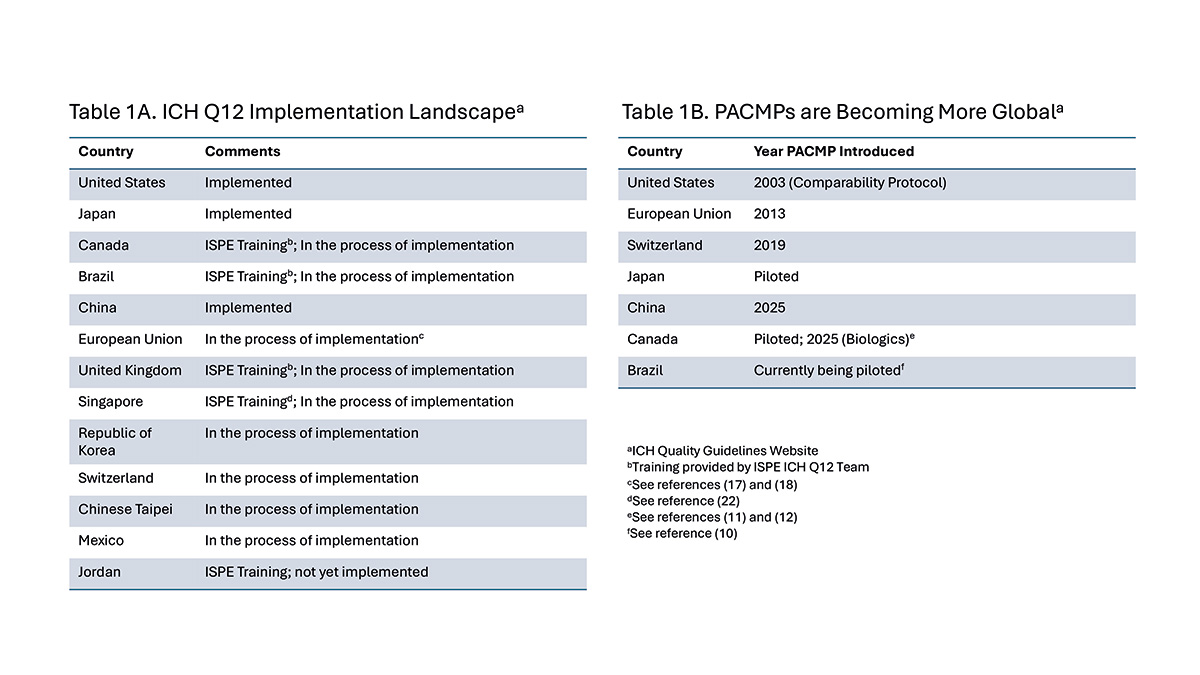
ICH Q12 states that “a harmonized approach regarding technical and regulatory considerations for lifecycle management will benefit patients, industry, and regulatory authorities by promoting innovation and continual improvement in the pharmaceutical sector, strengthening quality assurance and improving supply of medicinal products.” This article, based on responses from the survey, describes the concerns for a lack of global implementation (see Table 1) as companies seek universally accepted strategies to manage their products throughout the life cycle.
Tools Evaluated
ICH Q12 introduces several tools that enable product life cycle management, with a focus on the postapproval change management of pharmaceutical products. These tools ensure pharmaceutical products’ quality, safety, and efficacy throughout the products’ commercial life cycle. The tools evaluated as part of the ICH Q12 IQ survey include postapproval change management protocols (PACMPs), established conditions (ECs), and product life cycle change management (PLCM) documents.
Table 1. 1A) The ICH Q12 implementation landscape, and 1B) where PACMPs are becoming more global.
Postapproval Change Management Protocol
A PACMP provides predictability and transparency between the sponsor and regulatory agency when adopting a change. The protocol describes the chemistry, manufacturing, and controls (CMC) change that the marketing application holder intends to make, outlining specific conditions and acceptance criteria to be met under a future submission with a reduced reporting category.
ECs
ECs are legally binding information in the dossier considered necessary in assuring product quality. A change to an EC neces-sitates regulatory reporting, and the reporting category depends on the level of risk to product quality.
Product Life Cycle Change Management
Lastly, a PLCM document serves as a central repository for all identified ECs in the dossier, and the corresponding proposed reporting category if changing that EC. The PLCM is also intended to house PACMPs and any postapproval CMC commitments.
Survey Method
The CSGH and ICH Q12 WGs distributed the survey to IQ Consortium member companies, asking each to submit one coordinated response. Although individual respondents remain anonymous, they were expected to coordinate input from company subject matter experts in CMC strategy and policy, submissions, and product life cycle.
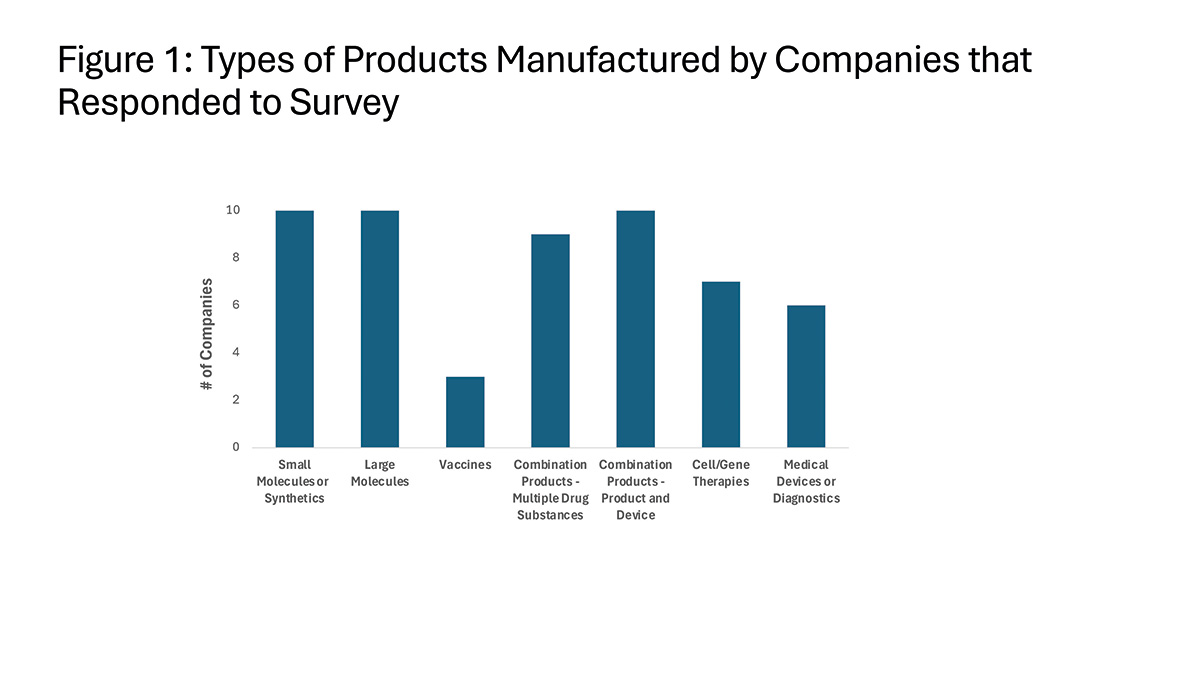
The survey had 15 main questions and multiple subquestions. The first few questions focused on details about the compa-ny/organization, followed by detailed short-answer questions about experiences with using tools made available by ICH Q12. The survey followed with free-text questions related to ICH Q12’s effect on organizations. Ten member companies provided responses to the survey; most were manufacturers of diverse modalities (see Figure 1).
The respondents reported manufacturing a variety of products, including small molecules, large molecules, and combination products. Advanced therapies such as gene and cell therapies were also represented, closely followed by medical devices, diagnostics, and vaccines. The authors acknowledge, as a stated limitation, that survey findings reflect self-reported perception based on real experience rather than independently verifiable outcomes.
Survey Results
The survey asked respondents to rank the primary drivers for using ICH Q12 at their company, with five answers provided and the option to choose “other.” The following responses were ranked from the most important to the least:
- Improve speed to adoption changes
- Align product control strategies across regions
- Reduce life cycle maintenance costs
- Reduce risk of drug shortage
- Improve product robustness
- Other
Surveyed companies said their highest-ranked motivations for implementing ICH Q12 were to improve speed to implement changes and to align product control strategies across regions. Respondents identified that other underlying drivers varied significantly across regions and regulatory frameworks. Survey takers said they may not necessarily be using these tools to improve product robustness, likely because they have other ways to support an understanding. For the two companies that did note “others,” both cited a need to “pre-align on harmonized reporting categories across regions.”
In regions where regulatory frameworks are more mature—such as the US, Canada, EU, and Japan—the primary motivation for participants applying PACMPs and other commitments is to improve speed to make changes and to realign on harmonized reporting categories across regions. A survey taker said that for products submitted in China, the companies are using these tools mainly to reduce regulatory uncertainty.
Although ICH Q12’s potential has yet to be consistently realized globally, the tools’ adoption, grounded in science- and risk-based approaches, represents industry’s pivotal move toward streamlined life cycle management, strategic supply chain management agility, and harmonized global control strategies.
Use of ICH Q12 Tools
The collected data showed widespread adoption of Q12 tools responding to a question on Q12 tools that the companies may have used or are using; 100% of companies reported using PACMPs or comparability protocols in the US. Also, 90% of respondents said they have used ECs, and 80% reported using PLCM strategies. These findings suggest that a majority of companies are ready to embrace Q12 tools, but further discussion will highlight that companies have only been able to register broadly with PACMPs.
PACMPs
PACMPs are the most broadly used Q12 tool, as some local legislation has allowed for using PACMPs in countries that have not fully implemented ICH Q12. Notably, guidance on recommendations to applicants on the preparation and use of comparability protocols in the US was issued in 20039 and their benefit was realized before ICH Q12 was adopted.
Industry responders have used PACMPs for small and large molecules, siRNA, vaccines, and antibody–drug conjugates (ADCs). The survey results showed some postapproval changes have leveraged PACMPs, including new manufacturing sites and lines, process changes to control strategy, adding starting material supplier and critical reagent source, adding analytical testing sites, batch size changes, shelf-life extension, analytical procedure changes, and container closure changes.
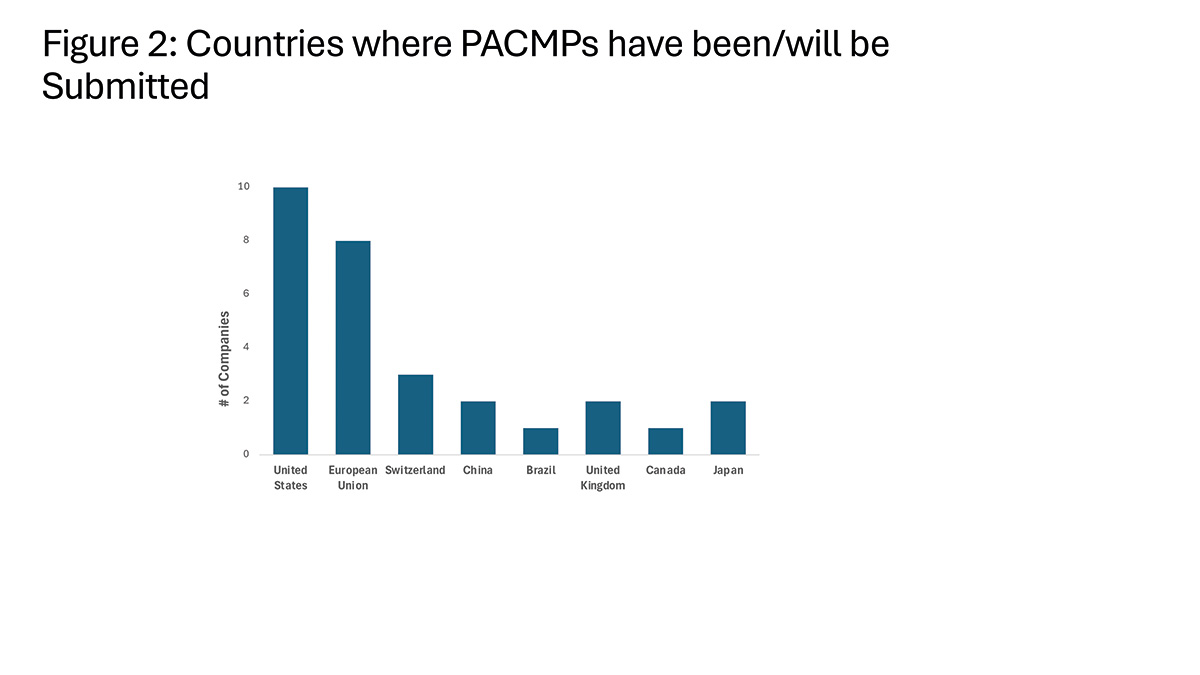
Industry respondents said they have submitted or planned to submit PACMPs to China, UK, Brazil, Switzerland, Canada, Japan, Europe, and the US (see Figure 2). Most responders have submitted PACMPs in Europe (80%) and the United States (100%). Of note is that Brazil is in the pilot phase for PACMPs,10 Canada recently completed its pilot program11and announced its implementation plan for products regulated by the Biologic and Radiopharmaceutical Drugs Directorate,12 and China issued a guideline on making postapproval CMC changes for chemical drug substances and drug products via a PACMP.13
The majority of industry respondents cited a successful outcome when using PACMPs. However, other respondents said their PACMPs have required meetings with regulatory authorities, delayed regulatory approval, or resulted in application rejection. Nearly half of responders stated their companies experienced varied regulatory requirements between individual health authorities when filing PACMPs.
The benefits of sponsors using a PACMP include a reduction in data required and reduced reportability, leading to a shortened review period and time to execution. Industry responders noted both reduced stability data and number of batches were approved as part of their PACMPs. Reportability downgrades considered acceptable by health authorities included PAS (Prior Approval Supplement for US submissions) to CBE-30 (changes being effected in 30 days), Type 2 (major change to an EMA marketing authorisation that requires formal approval) to Type 1B (minor change that requires a 30-day assessment period) vari-ation, Type 1B to Type 1A (minor change that does not require prior approval) variation, or PCA (major modification to an ap-proved marketing authorization in Japan) to MCN (minor modifications that do not require prior approval). Reportability downgrades were considered unacceptable when proposing a PAS to an annual reportable change, or site transfers that would require an inspection. Overall, 90% of survey respondents reduced data and reporting requirements as part of their PACMPs.
ECs and PLCM
ECs are a foundational concept introduced in the ICH Q12 guideline to enhance regulatory clarity and streamline post-approval change management throughout a pharmaceutical product’s life cycle. Survey respondents said experience with applications including ECs were mostly submitted to the US FDA (75%), with the remaining submissions being to Health Canada (25%). This response correlates strongly with the regions that initiated pilot programs for submissions with ECs. In these submissions, ECs were introduced as postapproval changes (56%) or as part of new marketing applications (44%).
The product types included both small and large molecules, encompassing biologics, biosimilars, and both sterile and non-sterile drug products. The majority of products were manufactured using batch manufacturing processes; however, application was noted in continuous manufacturing. Respondents reported leveraging ICH Q12 tools across multiple domains, with common application areas being drug substance manufacturing processes, drug product manufacturing processes, analytical procedures for release and stability testing, and raw materials, excipients, and respective controls.
Approaches to identifying ECs in manufacturing processes
ICH Q12 defines two primary approaches for identifying ECs in manufacturing processes: parameter-based and performance-based.
Parameter-based approach
The parameter-based approach includes both a minimal (or traditional) strategy, which relies on limited understanding and therefore encompasses a broad set of inputs and outputs, and an enhanced strategy, which leverages deeper knowledge of input-output relationships to focus ECs on critical parameters and outputs.
Performance-based approach
In contrast, the performance-based approach centers ECs on process outputs such as attributes and responses. Advanced process understanding, data-rich environments, and enhanced control strategies such as process analytical technology (PAT) and feedback controls support this performance-based approach. Although both approaches aim to manage risks to product quality, the choice and scope of ECs depend on the extent of product and process knowledge accumulated throughout the life cycle.1
Approach survey results
Most respondents (70%) used a parameter-based enhanced approach to define ECs. Nearly half (44%, four of nine respondents) reported submitting more data in their dossiers than they would have without proposing ECs, suggesting that the additional data was largely already available. Eleven percent (one of nine respondents) said that new experimental work was required to justify the proposed reporting categories for ECs, but 75% of respondents (six of eight respondents) were asked to justify aspects of the control strategy they had classified as supportive information rather than ECs. Thirty percent of respondents reported adopting a performance-based strategy, which was likely applied to analytical procedures, although the survey did not explicitly capture this detail.
The performance-based approach centers ECs on process outputs such as attributes and responses.
The majority of respondents that used a performance-based approach successfully reduced the total number of ECs and reported greater operational flexibility. About two-thirds of survey respondents felt there were no differences in applying Q12 tools to analytical procedures versus manufacturing processes.
However, respondents that observed differences provided valuable insights. One respondent noted that an analytical target profile (ATP) defines analytical performance requirements within control system testing to mitigate the risk of out-of-specification results; this makes it fundamentally different from the quality target product profile (QTPP). Another respondent said assigning reporting categories for analytical procedures using a performance-based approach was more complex than for manufacturing processes and attracted greater regulatory scrutiny. A third respondent expressed concern that accepting “ad-herence to ATP” would take time and found it disappointing that ICH Q14 Annex 1 includes a disclaimer stating that “the extent of ECs, actual reporting categories, and data requirements may differ by region.”7
Regulatory outcomes
Regulatory outcomes following EC applications were mixed. Most applications were approved without delays or barriers; however, four experienced challenges, including minimal delays (n = 2), withdrawal (n = 1), and rejection (n = 1). Four respondents used innovation-focused meetings with health authorities to boost understanding of proposals.
Four respondents achieved agreement on reduced data requirements and reporting categories. Two respondents reported partial regulatory relief; two reported no relief. Of the latter, one did not propose reductions, and the other said proposed reductions were not accepted. Specifically, requests for reduced reporting categories for drug product manufacturing process parameters and for control of materials were rejected, with authorities defaulting to guideline requirements (i.e., proposals for annual rather than immediate reporting were not accepted).
Respondents applied annual reevaluation of ECs inconsistently. Some companies incorporated EC review into their product quality review (PQR) or annual product quality review (APQR); others reported no formal process. Two respondents said revisions to ECs or reporting categories were required following initial approval.
The PLCM document, a key component of ICH Q12, was applied across a broad range of product types. Document length and complexity varied substantially, ranging from eight to more than 50 pages. All respondents (100%) reported approval of PLCM submissions without delays; however, 75% encountered divergent regulatory requirements when submitting to multiple markets. Most respondents did not use a single PLCM across countries, citing region-specific requirements and incomplete implementation of ICH Q12 in certain jurisdictions (e.g., Europe, Japan). None shared an approved PLCM with other markets, primarily because of timing mismatches and regulatory uncertainty.
Findings related to ECs and PLCMs highlight progress and continuing challenges in ICH Q12 implementation. Although evidence suggests movement toward more predictable regulatory practices, persistent variability across markets underscores the need for greater harmonization to fully realize the guideline’s intended benefits.
Control Strategy Divergence
The survey contained a series of questions relating to health authorities having divergent views on proposed control strategies. The first few questions were pertaining to areas of a CMC control strategy that were affected by differing views of health authorities. Six respondents ranked the areas most affected by divergent views from health authorities as 1) specifications, 2) drug substance process parameters, 3) drug product process parameters, and 4) analytical procedures, with five of the six believing this created significant complexity. Comments from the survey noted that this divergence can lead to reduced process capability, restricted ability to make postapproval changes, limited shelf life, and global medicine shortages. These results agree with the discussion presented in a recent industry study on global control strategy.8
The next series of questions on divergence focused on postapproval tools described in ICH Q12. When asked whether they had received divergent recommendations from different health authorities relating to approval of PACMPs, ECs, or PLCMs, 75% of the eight respondents said yes. The topics most affected and leading to divergence on EC and reporting categories were ranked as 1) drug substance process parameters, 2) drug product process parameters, 3) analytical procedures, and 4) specifications. This ordering changed from control strategy divergence, which is likely because of what’s proposed in a postapproval change. The examples were all related to PACMPs, as respondents noted that ECs had been proposed in only one market because Q12 hadn’t been widely implemented. In the comments to this question, a respondent cited inconsistencies as one market accepted a PACMP proposal and another had rejected the same proposal or required additional commitments. Further, some additional burden was observed in having to provide technical reports and that registration required more process parameters than had been expected.
Although PACMPs have been widely accepted and used successfully, there is still work to be done to broaden the implementation of ECs and PLCMs.
Discussion
The survey results underscore the importance of harmonizing regulatory expectations and improving the receptivity and effective adoption of ICH Q12 globally. Although PACMPs have been widely accepted and used successfully, there is still work to be done to broaden the implementation of ECs and PLCMs. Divergent regulatory requirements and additional data requests pose challenges to the effective use of ICH Q12 tools.
Global Implementation
In the survey responses, companies provided several comments on global implementation of the postapproval regulatory tools described in ICH Q12. PACMPs have become common in some markets and are being implemented in many other markets, including China and Brazil. Although it is encouraging that the guidelines on PACMP have been issued in China, the requirements are more extensive than in other regions, primarily because the guidelines must cover both domestic and global manufacturers. Over time, it is desired that as regulators become more familiar with these types of submissions, greater alignment with Q12 will be achieved.
PACMPs
In most instances described, the reporting categories outlined in PACMPs have been agreed upon, but sometimes markets have deviated to request additional content requirements or changes to the proposed reporting categories. A company detailed positive experiences with PACMP submissions through the International Coalition of Medicines Regulatory Authorities (ICMRA) pilot program in the United States, Europe, United Kingdom, and Switzerland, receiving approvals without delays and achieving alignment of data requirements across regions for step 1 and plan to file step 2 for full implementation of a postapproval change. PACMPs are becoming an important regulatory tool for managing postapproval changes, but the instances with a lack of harmonization slow the progression. Collaborative review under ICMRA pilots provides a necessary step toward global reliance.14
ECs and PLCM
ECs adoption has been slower and mostly limited to the US so far,15 causing added workload with limited benefit because of restricted scope and lack of widespread regulatory implementation. Many countries are awaiting changes in legislation to permit ECs; others have implementation dates far into the future. For example, in Europe, “additional scientific risk-based approaches to defining ECs and associated reporting categories, as described in Chapter 3.2.3, and the PLCM Document, as described in Chapter 5, are not considered compatible with the existing EU legal framework on variations.”16 However, it was believed that publishing the Variations Guidelines in Europe revision, applicable in January 2026, would be a positive step forward.17 The revision incorporates discussion of additional regulatory tools, describing the continued use of a PACMP and introduced PLCM.
The European Medicines Agency (EMA) recently issued a Q&A on the use of a PLCM document. This Q&A stated that “future variation submissions must follow the appropriate classification as defined in the Annex of the current EU Variations Guideline, regardless of the variation type listed in the PLCM.”18 Statements such as this preclude industry from implementing ECs and a PLCM with the risk-based approach described in ICH Q12. Overall, with the ability to propose ECs available in so few markets, companies have not advanced the use of ECs because they view the tool as having limited benefit because of lack of global implementation.
The Need for Harmonized Adoption
The tools’ full potential, described in ICH Q12, can be achieved only with widespread and harmonized implementation by health authorities globally. If implementation is limited to a few regions or if interpretation of ICH Q12 varies significantly, these tools could counteract efforts to increase efficiency and foster innovation. Companies have cited divergent views from health authorities as significant concerns in the approval of control strategies because this leads to challenging approvals and life cycle management.
Feedback from companies emphasizes recommendations for improving the current state for the industry through establishing a robust pharmaceutical quality system, managing knowledge and communicating with health authorities through strong collaboration, sharing experiences, and highlighting positive life cycle impacts. For health authorities, training programs, collaborative reviews, and reliance were suggested to support harmonization and transparency.
Recommendations
Based on the responses from the survey, the following recommendations can be made. First, industry should continue advocating for ICH Q12’s consistent and timely implementation among global health authorities, including alignment of reporting categories. Health authorities should expedite changes needed to local regulatory frameworks for faster implementation and should ensure local training and understanding of ICH Q12 concepts for a harmonized approach across regions.
Continuing dialogue and communication of case studies between industry and health authorities will help progress understanding not only of ICH Q12 but also ICH Q14 with regard to analytical procedure changes.
Industry should continue to use ICH Q12 tools to develop more case studies for sharing information such as lessons learned, successes, and practical challenges faced internally by companies in implementing ICH Q12. Information sharing can occur at conferences and through publications.19, 20, 21 Industry organizations such as ISPE have also developed and delivered training sessions on ICH Q12 to various health authorities with detailed discussions of case studies.22
Additionally, there are multiple efforts, including the use of reliance pathways, to encourage collaborative reviews among health authorities. These efforts enhance mutual understanding by allowing health authorities to share assessment reports and queries and can substantially reduce duplicative work.
For example, ICMRA14 has conducted pilots for postapproval CMC changes, with participants/observers including the EMA, Medicines and Healthcare Products Regulatory Agency (MHRA), US FDA, Swissmedic, Health Canada, Agência Nacional de Vigilância Sanitária (ANVISA), Health Sciences Authority (HSA), and Pharmaceuticals and Medical Devices Agency (PMDA). To streamline information sharing, postapproval CMC change pilot programs are arising on cloud-based platforms.23, 24, 25 These pilot programs for CMC changes have been shown to greatly accelerate obtaining approvals in different countries and should continue to foster support for the use of harmonized ICH Q12 principles.
Conclusion
In conclusion, ICH Q12 tools have shown promise in improving postapproval change efficiency and aligning control strategies across regions. However, ICH Q12’s full potential can be realized only with widespread, harmonized global implementation by health authorities. Continued efforts to harmonize regulatory expectations and provide clear guidelines for using ICH Q12 tools are essential for the pharmaceutical industry to speed postapproval change management, which will expedite global patient access and advance pharmaceutical innovation while avoiding potential supply chain disruption.
Acknowledgments
The authors would like to acknowledge the CSGH WG, ICH Q12 WG, and IQ for their contributions to the subject matter discussed in this article. In particular, KeAndra Robinson is acknowledged for her efforts in leading the CSGH WG and for her assistance in coordinating the survey. Also, the authors would like to thank the companies that participated in the survey.