

Pharmaceutical compounding (503B) is compounding pharmacies with outsourcing facilities that may manufacture large batches with or without prescriptions to be sold to healthcare facilities for office use only. 503B compounding pharmacies that provide patient-specific medications are held to higher regulatory standards. These facilities must comply with current good manufacturing practices (CGMP).

iSpeak Blog
The Air-Liquid Interface Is a Process Parameter
A biologic drug product compounding step often transfers seamlessly on paper. The formulation is…

iSpeak Blog
Navigating the US Food and Drug Administration (US FDA) Outsourcing Facility Inspections Compliance Program
At the 2025 ISPE Annual Meeting & Expo in Charlotte, North Carolina, USA, the authors presented on…

Video
Panel Discussion on Recent ISPE Article on Visual Inspection for 503B's
Panel Discussion on Recent ISPE Article on Visual Inspection for 503B's Complimentary Learning Level…

iSpeak Blog
Pharmaceutical Compounding: A US FDA Perspective
The presentation by Ian Deveau, PhD, from the US Food and Drug Administration (US FDA) Office of…
PE Articles
New Guide for Compounding Pharmacies
In April 2024, ISPE published the ISPE Guide: 503A Compounding - Regulatory Basis and Industry Good…
iSpeak Blog
New ISPE Guide Provides Support for 503A Compounding Community
A recently released guidance document, the ISPE Guide: 503A Compounding – Regulatory Basis and…
Product
Guide: 503A Compounding
Published: April 2024 Pages: 72 Table of Contents Special Pricing for Emerging Economies Following…
Product
Guide: 503B Compounding
Published: August 2023 Pages: 122 Table of Contents Special Pricing for Emerging Economies An ISPE…
Video
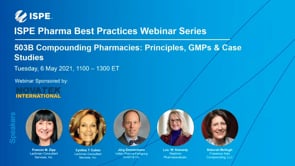
503B Compounding Pharmacies: Principles, GMPs and Case Studies Webinar
Complimentary Learning Level: Advanced Session Length: 2 hours In the early 2010s, there were…
Join the Conversation
As an ISPE member you can engage with 22 active CoPs, including new communities focused on Artificial Intelligence and Sustainability. Connect with experts and join the conversations: Become an ISPE member
ISPE members: Get more involved by volunteering.
Guidance Documents
Compounding (2)
Good Manufacturing Practice (1)
Quality Assurance (1)
Pharmaceutical Job Board
Community Discussions
Community Discussions
Webinars
iSpeak Blog Posts
iSpeak Blog
The Air-Liquid Interface Is a Process Parameter
A biologic drug product compounding step often transfers seamlessly on paper. The formulation is…
iSpeak Blog
Navigating the US Food and Drug Administration (US FDA) Outsourcing Facility Inspections Compliance Program
At the 2025 ISPE Annual Meeting & Expo in Charlotte, North Carolina, USA, the authors presented on…
iSpeak Blog
Pharmaceutical Compounding: A US FDA Perspective
The presentation by Ian Deveau, PhD, from the US Food and Drug Administration (US FDA) Office of…
iSpeak Blog
New ISPE Guide Provides Support for 503A Compounding Community
A recently released guidance document, the ISPE Guide: 503A Compounding – Regulatory Basis and…
Special Initiative Documents

Pharmaceutical Engineering® Magazine
PE Articles
New Guide for Compounding Pharmacies
In April 2024, ISPE published the ISPE Guide: 503A Compounding - Regulatory Basis and Industry Good…
Professional Development Training
Commissioning and Qualification Microlearning: Periodic Review
The "Periodic Review" section of the Science & Risk-based Commissioning and Qualification (T40) training course examines how periodic review supports the continued maintenance of systems in a validated and qualified state. Participants explore the regulatory expectation that systems remain suitable for their intended purpose through lifecycle controls such as change control, maintenance, calibration, deviation management, and performance monitoring. The module also introduces a risk-based approach to determining periodic review frequency, including the use of review categories based on system…
Commissioning and Qualification Microlearning: Process Control and Automation
The "Process Control and Automation" section of the Science & Risk-based Commissioning and Qualification (T40) training course examines how GAMP® Quality Risk Management principles can be integrated with science- and risk-based C&Q for process control systems. Participants explore the relationship between manufacturing systems, process equipment, sensors, actuators, and Process Control Systems (PCS), as well as how product and process knowledge, Critical Quality Attributes (CQAs), and Critical Process Parameters (CPPs) inform automation and control requirements. The module also covers the…
Commissioning and Qualification Microlearning: Acceptance and Release
The "Acceptance & Release" section of the Science & Risk-based Commissioning and Qualification (T40) training course examines the final review and formal release of systems following the commissioning and qualification activities. Participants explore how testing results, discrepancies, engineering changes, and required quality system elements are reviewed to determine whether a system is suitable for manufacturing operations, the next stage of qualification, or use in PPQ or commercial production. The module also covers the transition of system ownership from the project team to operations…
Commissioning and Qualification Microlearning: Good Documentation Practice for Commissioning and Qualification
The "Good Documentation Practice for C&Q" section of the Science & Risk-based Commissioning and Qualification (T40) training course examines the documentation principles used to support clear, accurate, and reliable C&Q records. Participants explore how Good Documentation Practice supports data integrity through records that are attributable, legible, contemporaneously recorded, original or a true copy, and accurate. The module also compares commissioning and qualification documentation, including differences in approval, testing strategy, acceptance criteria, engineering judgment, Quality…
Commissioning and Qualification Microlearning: Implementation Strategy for New and Legacy Systems
The "Implementation Strategy for New & Legacy Systems" section of the Science & Risk-based Commissioning and Qualification (T40) training course examines how organizations can transition to a science- and risk-based C&Q approach for both new and existing systems. Participants explore the importance of organizational readiness, senior management support, quality systems, Good Engineering Practice (GEP), staff training, and a defined implementation plan when introducing a new C&Q strategy. The module also covers how the approach can be adapted for new projects, major changes, minor changes, and…