Investigational Products (Invest Prod) refers to a preventative (vaccine), a therapeutic (drug or biologic) device, diagnostic, or palliative used in a clinical trial. An investigational product may be an unlicensed or licensed product when used or assembled (formulated or packaged) differently from the approved form, when used for an unapproved indication, or when used to gain further information about an approved use.
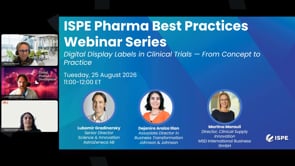
Video
Digital Display Labels in Clinical Trials — From Concept to Practice
Digital Display Labels in Clinical Trials — From Concept to Practice Complimentary Learning Level…

iSpeak Blog
Just-in-Time (JIT) vs Just-in-Case: The Shift Toward Demand-Led Clinical Supply
Global clinical trials play a vital role in advancing medical research and improving patient care…

PE Articles
Volunteer Profile: Andrea Martina Zobel, PhD, Investigational Products Europe Community of Practice (CoP) Chair
As the Senior Director of Personalized Supply Chain at Cencora World Courier (formerly…

PE Articles
Adoption and Implementation of Innovative Technologies in CMC
The often-overlooked function of chemistry, manufacturing, and controls (CMC) holds tremendous…

Video
How to Perform a Compliant Human Error Investigation
How to Perform a Compliant Human Error Investigation Complimentary Learning Level: Advanced Session…

PE Articles
Use of Booklet Labels on Investigational Medicinal Products (IMPs)
The objective of this concept paper is to reflect on a study site survey performed, to draw…

PE Articles
The Application of GAMP® 5 to the Implementation and Operation of a GxP Compliant Clinical System
The need to validate computerized systems used in the context of a clinical trial has increasingly…

PE Articles
Validation & Data Integrity in eClinical Platforms
To address the trial specific setups, eClinical solutions have to be built from various integrated…

iSpeak Blog
Empowering Novel Therapies: Automation Best Practices for cGMP Processes
Novel therapies refer to innovative and often groundbreaking approaches to treating medical…

PE Articles
Investigator Initiated Trials (IIT) – Considerations and Guidance from the Perspective of Clinical Trial Supplies and GMP
This Concept Paper is designed to give a better understanding of the challenges and requirements…

Product
Comprehensive Guide to Clinical Materials
The Guide is designed to provide a valuable tool for the development of in-house training sessions…

Product
Good Practice Guide: Comparator Management
Published: February 2012 Pages: 84 Table of Contents Special Pricing for Emerging Economies The ISPE…
Join the Conversation
As an ISPE member you can engage with 22 active CoPs, including new communities focused on Artificial Intelligence and Sustainability. Connect with experts and join the conversations: Become an ISPE member
ISPE members: Get more involved by volunteering.
Guidance Documents
Biotechnology (1)
Investigational Products (8)
- Comprehensive Guide to Clinical Materials
- Good Practice Guide: Comparator Management
- Good Practice Guide: Development of Investigational Therapeutic Biological Products
- Good Practice Guide: IMP Reverse Logistics
- Good Practice Guide: Harmonizing the Definition and Use of NIMPs
- Good Practice Guide: Clinical Supply Systems
- Good Practice Guide: Interactive Response Technology
- Introductory US Clinical Trial Materials Training Guide
Supply Chain Management (1)
Pharmaceutical Engineering Magazine Articles
Volunteer Profile: Andrea Martina Zobel, PhD, Investigational Products Europe Community of Practice (CoP) Chair
As the Senior Director of Personalized Supply Chain at Cencora World Courier (formerly…
Adoption and Implementation of Innovative Technologies in CMC
The often-overlooked function of chemistry, manufacturing, and controls (CMC) holds tremendous…

Introducing CoP Leader Profiles: Rachel Owen
With this issue, Pharmaceutical Engineering ® launches a new feature in P+E: profiles of Communities…

A New Regulatory Approach to Drive Sustainable Medicines
To enable changes across the pharmaceutical industry, sustainability should be included alongside…

Model-Informed Drug Development Addresses COVID-19 Challenges
Drug developers know that the odds of anyone compound demonstrating safety and efficacy for a…
White Papers
September / October 2026
This issue examines the intersection of quality and regulatory innovation, tracing the evolution of…
July / August 2026
This issue explores how digital transformation is reshaping regulated industries, highlighting…
May / June 2026
This issue explores the evolving landscape of Advanced Therapy Medicinal Products (ATMPs), examining…

Pharmaceutical Job Board
iSpeak Blog Posts
Professional Development Training
Commissioning and Qualification Microlearning: Periodic Review
The "Periodic Review" section of the Science & Risk-based Commissioning and Qualification (T40) training course examines how periodic review supports the continued maintenance of systems in a validated and qualified state. Participants explore the regulatory expectation that systems remain suitable for their intended purpose through lifecycle controls such as change control, maintenance, calibration, deviation management, and performance monitoring. The module also introduces a risk-based approach to determining periodic review frequency, including the use of review categories based on system…
Commissioning and Qualification Microlearning: Process Control and Automation
The "Process Control and Automation" section of the Science & Risk-based Commissioning and Qualification (T40) training course examines how GAMP® Quality Risk Management principles can be integrated with science- and risk-based C&Q for process control systems. Participants explore the relationship between manufacturing systems, process equipment, sensors, actuators, and Process Control Systems (PCS), as well as how product and process knowledge, Critical Quality Attributes (CQAs), and Critical Process Parameters (CPPs) inform automation and control requirements. The module also covers the…
Commissioning and Qualification Microlearning: Acceptance and Release
The "Acceptance & Release" section of the Science & Risk-based Commissioning and Qualification (T40) training course examines the final review and formal release of systems following the commissioning and qualification activities. Participants explore how testing results, discrepancies, engineering changes, and required quality system elements are reviewed to determine whether a system is suitable for manufacturing operations, the next stage of qualification, or use in PPQ or commercial production. The module also covers the transition of system ownership from the project team to operations…
Commissioning and Qualification Microlearning: Good Documentation Practice for Commissioning and Qualification
The "Good Documentation Practice for C&Q" section of the Science & Risk-based Commissioning and Qualification (T40) training course examines the documentation principles used to support clear, accurate, and reliable C&Q records. Participants explore how Good Documentation Practice supports data integrity through records that are attributable, legible, contemporaneously recorded, original or a true copy, and accurate. The module also compares commissioning and qualification documentation, including differences in approval, testing strategy, acceptance criteria, engineering judgment, Quality…
Commissioning and Qualification Microlearning: Implementation Strategy for New and Legacy Systems
The "Implementation Strategy for New & Legacy Systems" section of the Science & Risk-based Commissioning and Qualification (T40) training course examines how organizations can transition to a science- and risk-based C&Q approach for both new and existing systems. Participants explore the importance of organizational readiness, senior management support, quality systems, Good Engineering Practice (GEP), staff training, and a defined implementation plan when introducing a new C&Q strategy. The module also covers how the approach can be adapted for new projects, major changes, minor changes, and…
Featured Conferences