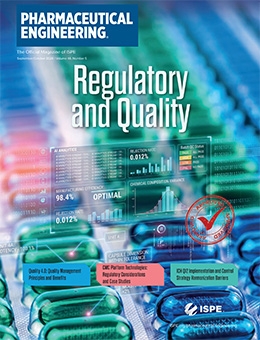
Pharmaceutical Engineering September/October 2026 Cover

Downloads

Issue PDF (5.21 MB)

Quality 4.0: Part 1 - Quality Management Principles and Benefits

Cover: Quality 4.0 integrates traditional quality management practices with advanced digital technologies such as artificial intelligence (AI), Internet of Things (IoT), big data analytics, cloud computing, and machine learning (ML).

CMC Platform Technologies: Regulatory Considerations and Case Studies - Part 1

Feature: Platform technology is gaining importance as regulators and industry seek tools to streamline regulatory approaches. In this article, we discuss how organizations might use platform technology in regulatory submissions to improve process efficiency for regulators and industry.

A Practical Guide for near Concurrent Collaborative Reliance

Feature: Global chemistry, manufacturing, and controls (CMC) postapproval changes (PACs) are still managed largely through fragmented, countryby- country processes that duplicate sponsor and regulator effort, increase cost, prolong implementation timelines, add supply chain complexity, discourage continual improvement, and delay patient-centric enhancements.

ICH Q12 Implementation and Control Strategy Harmonization Barriers

Feature: ICH Q12’s intent is to enable a holistic control strategy and provide regulatory tools for continual improvement over the product life cycle, thereby promoting innovation. However, slow implementation of ICH Q12 tools by regulatory agencies has created challenges for industry to fully use Q12 concepts in regulatory submissions.

Quantifying the Limitations of Fixed Physical Temperature Buffers

Technical: Physical temperature buffers function as lowpass filters on the thermal environment of pharmaceutical storage units and are widely used to dampen transient fluctuations and mimic product thermal behavior. This article presents a study that quantifies the limitations of fixed physical buffering and evaluates model-based buffering’s ability to address those limitations.

In This Issue

Features

Global chemistry, manufacturing, and controls (CMC) postapproval changes (PACs) are still managed largely through fragmented, country-by-country processes that duplicate sponsor and regulator effort, increase cost, prolong implementation timelines, add supply chain complexity, discourage continual improvement, and delay patient-centric enhancements.

Features

ICH Q12’s intent is to enable a holistic control strategy and provide regulatory tools for continual improvement over the product life cycle, thereby promoting innovation. However, slow implementation of ICH Q12 tools by regulatory agencies has created challenges for industry to fully use Q12 concepts in regulatory submissions.

Technical

Physical temperature buffers function as low-pass filters on the thermal environment of pharmaceutical storage units and are widely used to dampen transient fluctuations and mimic product thermal behavior. This article presents a study that quantifies the limitations of fixed physical buffering and evaluates model-based buffering’s ability to address those limitations.
Technical

Bioreactor contamination can be one of the most troublesome and costly deviations to resolve in a GMP manufacturing facility. That’s both because cell culture unit operations are inherently susceptible to contamination and because tracking down the source of contamination can be extremely difficult.

InTouch

Two typhoons were approaching Shonan, and we were preparing to launch Japan’s first Emerging Leaders Hackathon. In the days leading up to the event, unstable weather made everything feel uncertain. The storms passed, but a sense of nervous anticipation remained.

InTouch
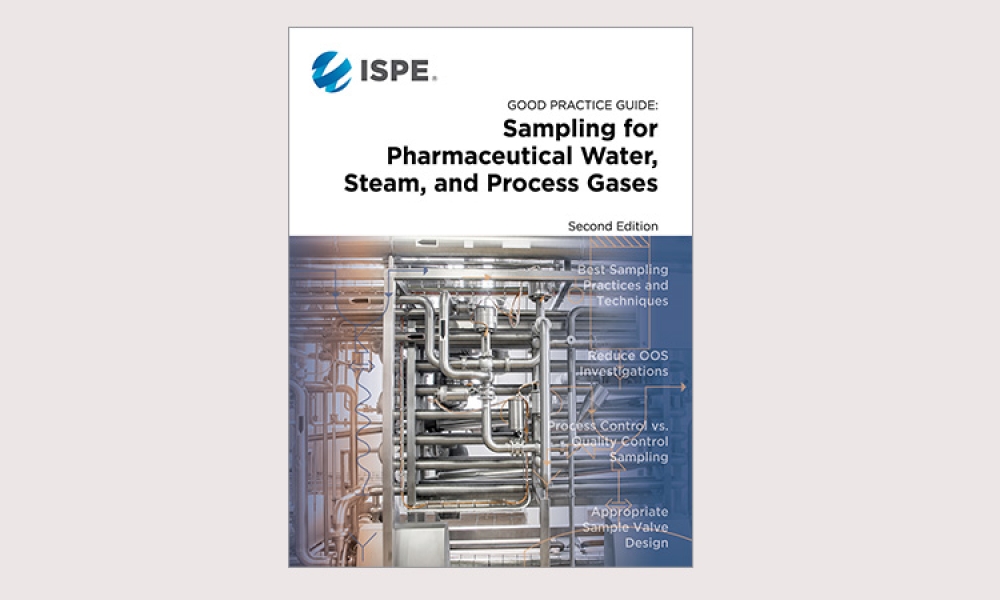
Effective sampling is essential to quality assurance in pharmaceutical manufacturing. The updated ISPE Good Practice Guide: Sampling for Pharmaceutical Water, Steam, and Process Gases, Second Edition, explains how improper sampling can have significant consequences.
Insights
Renowned psychologist Abraham Maslow wrote in his 1966 book, The Psychology of Science, “I suppose it is tempting, if the only tool you have is a hammer, to treat everything as if it were a nail”. Maslow’s quote comes to mind when considering a leadership approach to managing teams.
Insights

Regulatory harmonization has advanced substantially. Yet a manufacturer can present the same science or technical justification to multiple authorities and receive different responses, including change classifications, data requests, timelines, and inspection expectations.

This issue examines the intersection of quality and regulatory innovation, tracing the evolution of Quality Management from defect detection to continuous improvement and operational excellence. It aims to provide practical insights into advancing quality, efficiency, and regulatory flexibility across the pharmaceutical industry.