Formulation Choices in Cannabidiol Drug Development Beyond Dispersion
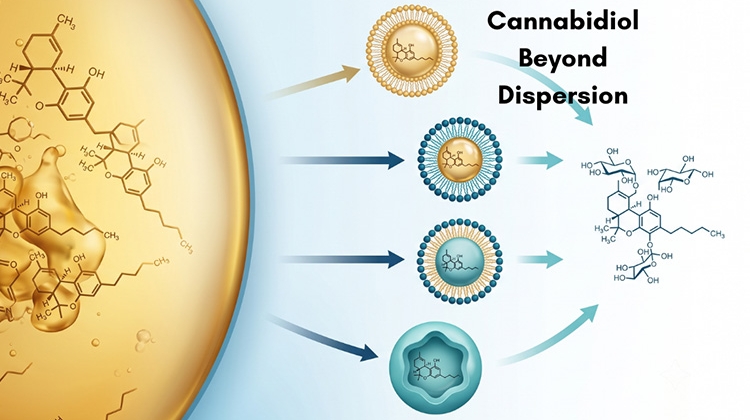
Cannabidiol (CBD) presents a familiar, but demanding, drug-product problem: a highly lipophilic active molecule must be delivered through aqueous physiological environments, which can be reproduced. For prospective pain and inflammatory indications, formulation development therefore needs to distinguish carefully between improving the presentation of hydrophobic CBD and changing the physicochemical characteristics of the active molecule itself.
CBD’s low aqueous solubility, high lipophilicity, sensitivity to environmental stressors, and extensive first-pass metabolism could each contribute to variable exposure after oral administration. These constraints cannot establish clinical benefit or lack of benefit in any pain or inflammatory condition. They do, however, make dosage-form design, manufacturing control, and clinical interpretation inseparable.
The Physicochemical Constraint
CBD is a 21-carbon terpenophenolic compound with a substantial hydrophobic region. Its reported lipophilicity and low water solubility place dissolution and solubilization at the center of oral drug-product development. In practical terms, water is a poor continuous phase for unmodified CBD, while oils and other nonpolar domains are more accommodating.
For a conventional oral solid dosage form, absorption ordinarily requires drug dissolution in gastrointestinal fluid before permeation can occur. A hydrophobic compound may dissolve slowly or incompletely, and the concentration available at the absorptive surface may depend strongly on food, bile-mediated solubilization, gastrointestinal conditions, and the formulation’s behavior during digestion. CBD is also subject to pre-systemic metabolism, so a formulation that improves dispersion or dissolution does not, by itself, resolve every contributor to systemic exposure.
The implication is not that every CBD product must pursue maximal aqueous solubility. The appropriate target product profile may instead prioritize localized delivery, modified release, oral exposure, rapid onset, or dosage-form convenience. The formulation strategy should follow that profile, with explicit recognition of what physicochemical barrier is being addressed and what remains unchanged.
Current Formulation Approaches
Suspensions are among the most direct options. In these systems, solid CBD particles remain undissolved and are dispersed in a liquid vehicle. Particle-size reduction can increase surface area and may improve the dissolution rate, but it does not increase intrinsic solubility, sedimentation, crystal growth, re-dispersibility, dose uniformity, and particle-size control become critical quality considerations.
Emulsions and nanoemulsions place CBD in an oil phase dispersed as droplets within an aqueous continuous phase. Smaller droplets can improve physical dispersion, increase interfacial area, and provide a more uniform liquid presentation. Yet the CBD remains principally within an oily domain, and the oil droplets require a sufficiently robust emulsifier system to resist coalescence, phase separation, and changes induced by temperature, dilution, or gastrointestinal digestion.
Self-emulsifying drug-delivery systems use oils, surfactants, and sometimes co-solvents that form fine dispersions on contact with aqueous media. They can maintain a lipophilic drug in a solubilized state during initial gastrointestinal transit, but formulation performance depends on the balance of lipid composition, surfactant concentration, dilution behavior, precipitation risk, capsule compatibility, and digestive transformation. The formulation must therefore be evaluated under biorelevant conditions rather than inferred from visual clarity alone.
Lipid-based systems more broadly may include oily solutions, structured lipid particles, liposomes, and related vesicular systems. These systems can protect the drug from some external stresses and may support delivery through lipid-processing pathways. They also introduce development questions concerning oxidative stability, excipient variability, fill-weight accuracy, lipid crystallization, leakage, and the scalability of mixing and homogenization operations.
Cyclodextrin inclusion complexes offer a different, but still noncovalent, route. A cyclodextrin’s hydrophobic cavity can associate with a lipophilic guest while its exterior interacts with water, producing an increase in apparent aqueous solubility under suitable conditions. Complex stoichiometry, phase-solubility behavior, drug loading, dilution stability, and the possibility of free versus complexed CBD in the relevant biological environment require direct characterization.
Amorphous solid dispersions disperse CBD at molecular or near-molecular scale within a polymeric matrix. By avoiding or reducing crystalline lattice energy, they can increase apparent solubility and dissolution rate. Their central limitation is physical stability: amorphous CBD may recrystallize, particularly under heat or humidity, so polymer selection, drug loading, moisture control, and long-term solid-state monitoring are central to the control strategy.
Polymeric nanoparticles, micelles, and encapsulated systems use amphiphilic or polymeric carriers to form small colloidal structures that contain CBD within a hydrophobic core or matrix. These systems can alter release kinetics and physical presentation, but they add process complexity. Particle-size distribution, aggregation, residual solvent, drug loading, release testing, sterilization compatibility where relevant, and scale-dependent mixing effects may become defining development risks.
Co-solvents and surfactants can also raise apparent CBD concentration in a liquid system. Their use is not intrinsically problematic, but formulation acceptability depends on route, dose, tolerability, excipient exposure, container closure interactions, and the risk that the drug precipitates as the system is diluted after administration.
Distinguishing the Systems
The terms “water-soluble,” “water-compatible,” and “dispersible” are often used loosely. In pharmaceutical development, they describe materially different systems and should not be treated as interchangeable.
- A suspension contains undissolved solid CBD particles in a liquid. It is physically heterogeneous, even when well mixed. Its performance depends on particle attributes and suspension stability.
- An emulsion contains droplets of one immiscible liquid dispersed in another. In an oil-in-water emulsion containing CBD, the cannabinoid is generally dissolved in the oil droplets, not molecularly dissolved throughout the aqueous phase. The oil phase remains chemically distinct and requires emulsifiers or other stabilizing mechanisms.
- A solution contains the active substance at the molecular level in the selected solvent system. It contains neither suspended solid particles nor dispersed oil droplets. A true aqueous solution is thermodynamically distinct from an emulsion, even if both appear visual uniform.
These distinctions matter because they determine the relevant failure modes and analytical methods. A suspension requires sedimentation and re-dispersibility studies. An emulsion requires droplet-size, interfacial, and phase-stability control. A solution requires assessment of molecular solubility, precipitation margin, and chemical stability. The same label claim may therefore conceal very different manufacturing and patient-use risks.
Many established CBD formulation technologies improve dispersion, suspension, emulsification, physical stability, dissolution rate, or apparent solubility. They generally do not convert CBD into a water-soluble molecule. The oil remains oi, and the native cannabinoid remains hydrophobic. The surrounding delivery system changes its presentation to the aqueous environment.
Molecular Modification
Molecular modification represents a separate design philosophy. Glycosylation, for example, refers to covalent attachment of one or more sugar moieties to a cannabinoid scaffold. Unlike emulsification, complexation, or encapsulation, this changes the molecular entity rather than the formulation environment.
A glycosylated cannabinoid may have different polarity, intermolecular interactions, molecular weight, solid-state properties, and aqueous solubility from CBD. Whether these changes are advantageous depends on the specific structure and intended route. They may also alter permeability, metabolism, receptor interactions, chemical stability, and distribution. Ther resulting entity should not be treated as native CBD merely because it is structurally related to CBD.
This represents a fundamentally different formulation strategy because molecular modification changes the physiochemical characteristics of the active molecule rather than modifying the surrounding formulation. In development terms, this shifts some risk from colloidal or multiphase formulation performance to molecular characterization, impurity control, bioconversion assessment where applicable, and demonstration of the modified entity’s pharmacology and safety.
Development Implications
The selection between carrier-based formulation and molecular modification should be made early, before the process is committed to a dosage form. Carrier-based systems may retain the original CBD molecular structure but can require substantial excipient loads, specialized processing, and controls for physical stability. Molecularly modified entities may support simpler aqueous processing in some cases, but they create a chemically distinct development program.
The ability to manufacture these products should be assessed as more than a scale-up question. Emulsification and nanoparticle processes may be sensitive to energy input, order of addition, temperature history, and equipment geometry. Solid dispersions may depend on thermal history, water activity, and polymer-drug miscibility. These dependencies should inform critical material attributes, process parameters, and stability protocols from the earliest formulation screen.
Sterile processing considerations should be addressed only when the route and dosage form require sterility. Colloidal systems may face filtration limitations related to droplet or particle size, while thermal sterilization may destabilize emulsions, polymers, or CBD itself. CBD has been reported to be susceptible to light, heat, and oxidation, making protective packaging, oxygen control, and stability-indicating analytical methods relevant across multiple dosage forms.
Regulatory characterization must also align with the actual system. For a suspension or emulsion, demonstrating content uniformity is not sufficient without understanding physical stability through shelf life and use. For an amorphous dispersion, solid-state form and recrystallization risk are central. For a modified cannabinoid, the active metabolite or reconversion profile become central chemistry, manufacturing, and controls questions.
Limitations
The evidence base remains formulation specific. Improved in vitro dissolution, smaller droplet size, or higher apparent solubility cannot be assumed to produce proportional changes in human exposure, clinical performance, or tolerability. CBD absorption varies with route, food intake, metabolism, and formulation behavior, and these variables must be evaluated in appropriately designed human pharmacokinetic studies.
Evidence for CBD in pain and inflammatory settings is also heterogenous across indications, formulations, endpoints, and cannabinoid compositions. Formulation science can reduce uncertainty in dose delivery, but it cannot substitute for controlled clinical evaluation of benefit and risk for a defined indication.
Comparative studies should therefore use clinically relevant dose levels and characterize the administered system before, during, and after relevant stress conditions. For complex systems, the useful comparison is not simply “soluble” versus “insoluble,” but molecular solution, colloidal dispersion, free drug concentration, release behavior, chemical stability, and exposure variability.
Way Forward
CBD formulation development is likely to benefit from closer integration of medicinal chemistry, physical pharmacy, and manufacturing science. The central question is not which technology is most advanced in general, but which strategy provides a controllable drug product whose mechanism of delivery, stability profile, and critical quality attributes fit the intended clinical use.
That discipline begins with accurate terminology. A stable dispersion can be valuable without being a true aqueous solution. An emulsion can improve dose presentation without changing CBD’s molecular hydrophobicity. A covalent modification can change molecular properties, but it also defines a new active entity that requires correspondingly rigorous pharmaceutical and clinical characterization.